Committed To Quality, Committed To You
For calcium carbonate processors, product value is determined not only by purity but also by particle size distribution. Whether it’s for paints, coatings, plastics, paper, rubber, pharmaceuticals, or construction chemicals, the buyer wants its particles to have a specific size and its size is a direct factor in its performance in the final product.
A paint manufacturer depends on consistent particle size for brightness, opacity, and surface finish. A plastics producer requires uniform particle distribution for better dispersion and mechanical properties. Pharmaceutical applications demand strict particle size control to meet regulatory and quality standards. In every case, the buyer is purchasing a defined grade — and the ability to consistently deliver that grade determines supplier competitiveness.
This is why calcium carbonate gradation is one of the most critical stages in mineral processing. And at the heart of this process lies the screening technology used to achieve it.
Achieving accurate calcium carbonate gradation is far more complex than simply separating material through a mesh screen.
The calcium carbonate is available in several grades (Ground Calcium Carbonate and Precipitated Calcium Carbonate) which have different particle morphology, flowability and bulk densities. Fine grades have low bulk density, making them difficult to handle efficiently and more challenging to classify accurately.
In many industrial applications there is no room for classification error as a tight size fraction is required. Near-size particles — those very close to the screen opening size — are particularly difficult to separate accurately and are often the source of inconsistent gradation output.
Agglomeration presents a further challenge. Fine calcium carbonate particles can cluster together during processing, behaving as oversized particles during screening. The lack of effective separation of these agglomerates will result in a distortion of the final particle size distribution and influence the performance of the product in the downstream applications.
Even a slight change in the gradation of the calcium carbonate may lead to off-spec material, customer complaints and product rejections for processors working for specification driven industries.
Conventional vibratory screens deliver reliable performance across many industrial screening applications. Some restrictions are more obvious, however, when the gradation for calcium carbonate requires a high degree of classification accuracy and narrow particle size tolerances.
In vibratory screening, the principle of operation is based on the vertical motion of material across the surface of the mesh. For fine calcium carbonate powder, this means particles close to the aperture size repeatedly bounce across the screen surface rather than passing through it — leading to misclassification. If the particles are larger than the specification, they will be in the reject fraction, which will directly impact the accuracy of gradation and product consistency.
Mesh blinding is a persistent challenge. Over time, fine particles of calcium carbonate build up in the screens and can cause less screening area and separation efficiency. As blinding increases through a production run, throughput drops and particle size classification becomes increasingly inconsistent — requiring frequent cleaning interventions that disrupt production.
Also, the mechanical energy of the vibration at high frequencies can cause particle breakage in fine powder applications, which is creating unwanted fines that could change the particle size distribution and complicating the ability to consistently meet the precise calcium carbonate gradation targets.
When the objective is precise calcium carbonate particle size separation, tumbler screening technology offers a fundamentally different approach to classification.
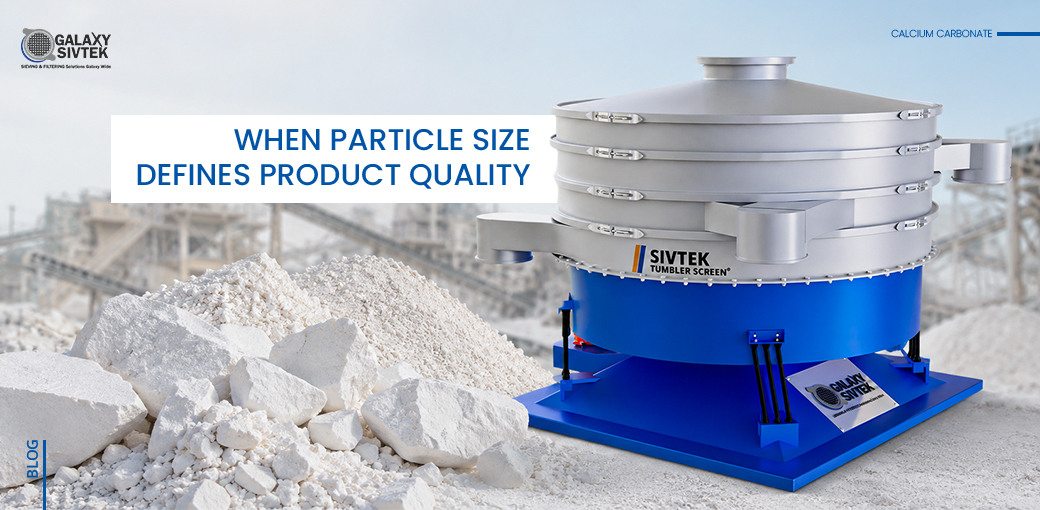
The Sivtek Tumbler Screen operates using a three-dimensional elliptical motion generated through combined radial and tangential forces. Material fed into the centre of the screen is moved spirally outwards, ensuring an even distribution on the entire surface of the screen. This gentle tumbling action closely simulates manual screening while maintaining industrial-scale throughput — and the result is significantly longer particle-to-screen contact time, which is critical for accurate separation of fine calcium carbonate powders.
Screening accuracy up to 99%. Particles remain on the screen surface longer, giving them greater opportunity to find and pass through the correct mesh openings. Processors routinely deliver improved particle size uniformity and conform to customer requirements for challenging applications.
Better separation of near-size particles. The controlled tumbling motion allows near-size particles — the most difficult to classify accurately — to interact with the mesh more effectively, resulting in cleaner separation between fractions and reduced off-spec output.
Mesh blinding significantly reduced. Mesh blinding is significantly reduced, the gentle tumbling action keeps rebalancing the material across the screen surface, minimising the build up of particles in mesh openings. Effective screening area is maintained throughout the full production run without frequent cleaning stoppages.
Particle integrity preserved. The Sivtek Tumbler Screen operates at 3 to 4 times lower acceleration than conventional vibratory screening systems. This gentle action reduces breakage of particles and prevents the creation of unwanted fines thus maintaining the particle size distribution as planned and not as affected and changed by the screening process.
Multi-fraction calcium carbonate gradation in a single pass. With up to five screening decks, the Sivtek Tumbler Screen separates material into up to six distinct size fractions simultaneously — allowing processors to serve multiple buyer grade specifications from one production run without additional processing steps.
Higher recovery of in-specification material. A high degree of particle classification see more particles in the required specification range, which not only increases product recovery, lowers material loss, but has a direct beneficial impact on the profit of processors producing premium grades of calcium carbonate.
Available in sizes from 48 to 84 inches, in SS 304, 316, and 316L stainless steel construction, the Sivtek Tumbler Screen is engineered for long-term reliability in demanding industrial calcium carbonate screening applications. Its low-noise operation — below 75 dB — is significantly quieter than conventional vibratory screening systems.
In the calcium carbonate industry, buyers are not simply purchasing a mineral — they are purchasing a particle size specification that directly influences the performance of their end product.
The ability to consistently achieve that specification depends on the effectiveness of the gradation process. While conventional vibratory screens perform reliably across many applications, fine calcium carbonate gradation demands greater screening accuracy, improved near-size particle separation, reduced mesh blinding, and better preservation of particle integrity — all of which tumbler screening technology is specifically designed to deliver.
As particle size specifications become increasingly stringent across premium application markets, the Sivtek Tumbler Screen is helping calcium carbonate processors deliver the consistency, precision, and reliability that modern industries demand.
Galaxy Sivtek provides advanced sieving, screening and filtration solutions for calcium carbonate processors supplying industrial, coating, pharmaceutical, and construction markets worldwide.
Connect with Galaxy Sivtek’s application team to find the right Tumbler Screen configuration for your calcium carbonate gradation requirements.