Committed To Quality, Committed To You
In the current rapidly changing flour industry, scaling production no longer solely concerns growing production effectively, but is also about ensuring that each of the stages involved in the process can effectively handle the increased production.
Many flour mills that used to depend on traditional vibro separators for screening flour are now facing a significant challenge: their current sieving systems just can’t keep pace with today’s production needs.
As production goals increase, these systems start to show their weaknesses, like limited throughput, inefficient plant layouts, and difficulties with integration. These inefficiencies do not only slow down the operations, it has direct effects on overall productivity and profitability.
Modern flour mills are moving toward high-capacity flour processing with continuous inline sieving systems. The current emphasis is on increasing productivity and simplifying processes.
Sieving in this environment is not only a quality control step any longer, but is a vital performance driver in the flour milling business. Any inefficiency at this point can cause bottlenecks in the whole production line.
It’s important to note that vibro separators in the flour industry are not obsolete. They continue to perform effectively in:
For many standard operations, vibro separators are a trusted and effective solution.
As production volume increases, however, practical challenges start to emerge – particularly in large capacity industrial flour mills.
One of the most common challenges is throughput limitation. As demand grows many millers have found that their flour processing with vibro separator machine cannot handle the increased production, and therefore they have production bottlenecks.
Another major concern is space. Vibro separators typically require significant floor area, which becomes a constraint when plants expand or optimize layouts. In modern facilities, where every square meter counts, this can hinder scalability.
Also, multiple sieving units can be connected in a continuous process which can result in a more complex system. The more connections, handling lines and transfer points the lower the operational efficiency and maintenance.
These challenges are not failures of the technology—they simply indicate that the system may not be designed for large-scale, high-throughput applications.
Many manufacturers are now using centrifugal sifters for high-capacity flour milling applications to overcome these limitations.
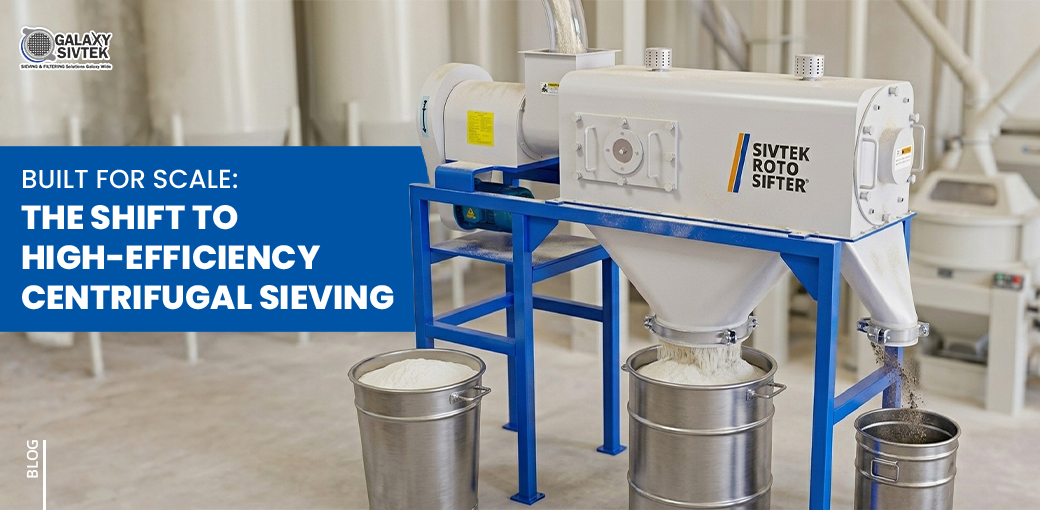
Unlike traditional vibratory screeners, centrifugal sifters use an internal rotating paddle design to continuously push flour through a cylindrical screening medium. They thus achieve faster flour screening, smoother flow of flour through the sifter systems, and significantly reduces the chance of blockage.
Perhaps most important, these machines are made to be used for inline flour sieving in continuous production lines, fitting well into modern production environments.
The adoption of centrifugal sifters can be attributed to several real operational limitations they solve.
The screening mechanism guarantees the uninterrupted flow of flour over the mesh, thus making the process more efficient and assuring a uniform separation. This is why they are suitable for high volume flour sieving applications where downtime does not occur.
One of the main benefits is that they are compact. Centrifugal sifters require much less operational space than traditional systems which makes them the preferred equipment choice for mills that face space restrictions or need to expand their facilities.
Multiple plants reported performance enhancements after they implemented centrifugal sifters for bulk flour processing. Throughput capacity increased from approximately 6.4 TPH to 10 TPH in some operations which resulted in a significant capacity expansion.
The transition toward centrifugal sifters is not driven by trends—it is driven by measurable results.
Flour mills adopting these systems are experiencing:
This change is a strategic upgrade for large-scale operations to more efficient flour processing systems.
There are a number of benefits that centrifugal sifters have that directly affect the performance of the plant.
They allow for continuous, high-volume production, which helps to increase production efficiency. They have a small footprint which means they do not waste space, especially when expanding a facility.
Complexity of operations is reduced as there is no need for additional handling systems because of inline installation. Meanwhile, regular screening can help maintain a uniform texture in the flour, as well as effectively removing impurities.
Over the long term, these improvements translate into lower maintenance, reduced downtime, and better return on investment.
When problems like production bottlenecks, space restrictions or growing system complexity occur, your flour mill might need to consider other options.
Industrial flour screening with centrifugal sifters are specially designed to overcome these problems, and to facilitate scalable growth.
The flour industry is continually changing, and the need to sieve efficiently, on a large scale and with limited space has grown more important than ever.
While vibro separators still play an important role in many applications, high-capacity flour mills increasingly require systems designed for continuous processing, higher throughput, and seamless integration.
Centrifugal sifters represent this next step in process optimization—helping manufacturers align their operations with growing industry demands.
If your existing sieving solution isn’t meeting your plants needs for efficiency or scalability, it’s high time to look at smarter solutions. Connect with our experts to evaluate your process and discover how centrifugal sifters can transform your operations.