Committed To Quality, Committed To You
Sugar is the backbone of the confectionery industry. In addition to its sweetness, it affects the texture, appearance, mouth feel, stability, and processing properties of a variety of products from chocolates & fondants to coatings, hard candies, icing sugar and more.
As confectionery products become more sophisticated and quality standards continue to rise, global brands are placing greater emphasis on ingredient consistency. For sugar suppliers, this means that sugar screening for confectionery manufacturers is no longer a back-end process — it is a front-line quality commitment. Delivering product that meets strict specifications batch after batch, without variation, is the baseline requirement for every buyer relationship in this industry.
And the stage where that consistency is either achieved or lost is confectionery grade sugar sieving.
Producing sugar that meets confectionery-grade standards is not simply about refining purity. It’s a matter of keeping the particle size accurate, eliminating the chance of contamination and uniformity between all batches, regardless of the production volume.
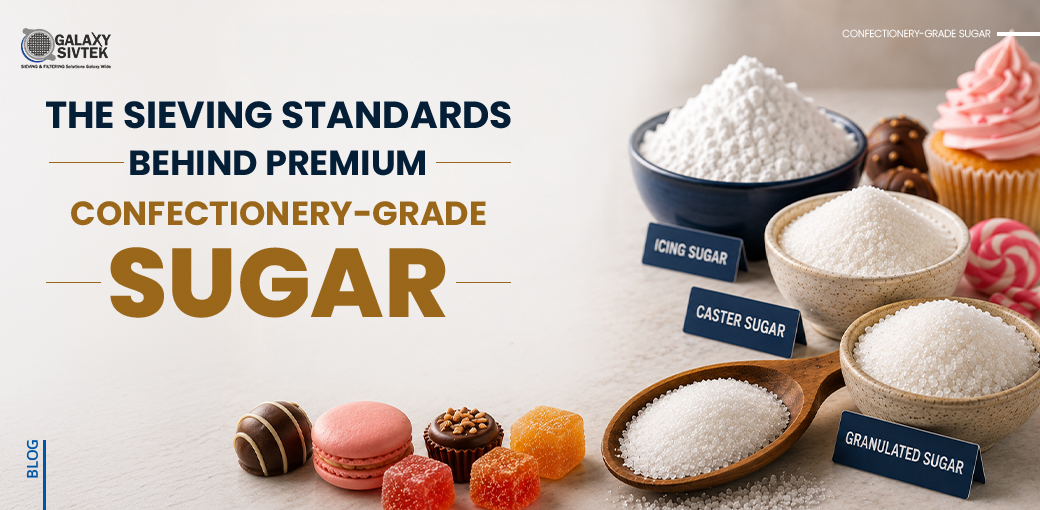
Inconsistent particle size distribution is one of the biggest challenges in sugar sieving. There is a variety of different types of confectionery applications which will use different grades of sugar and each grade of sugar has a different particle size specification. A reliable sieving solution for icing sugar, caster sugar, and granulated sugar must address each grade differently — icing sugar must dissolve quickly and completely to deliver a smooth finish; caster sugar requires fine, uniform crystals for whipping, creaming, and baking applications; granulated sugar used in coatings and decorative applications must remain within a controlled size range to ensure consistent adhesion and appearance.
When particle size varies from batch to batch, manufacturers experience inconsistent texture, uneven dissolution, and variations in product quality. These inconsistencies have a direct impact on the performance of the finished product for the confectionery manufacturing company. To sugar suppliers they affect confidence in the customers and sustainability of business relationships.
Agglomeration is another persistent challenge. Sugar can get soft lumps during the conveying, storage, and handling processes. Those agglomerates act like oversized particles and then you get trouble during mixing, coating, and blending, all because the behavior no longer matches what the process needs. In premium confectionery applications where smooth texture and uniformity are critical, even small lumps can lead to quality concerns or product rejection.
Contamination risk presents an additional challenge throughout production and handling. Sugar can meet foreign particles, bits from packaging residues, or other processing contaminants at multiple stages in the production line. For confectionery manufacturers operating under strict food safety management systems, contamination in incoming ingredients is unacceptable — and can result in rejected shipments, production delays, or supplier reviews.
Together, these challenges define the quality standards that confectionery-grade sugar suppliers must consistently meet.
There are a number of different product specifications for different applications, but there are certain expectations that are held by confectionery manufacturers.
They expect sugar that delivers predictable performance in every production run — uniform particle size profile, freedom from agglomerates, and product free from contamination. Equally important is batch-to-batch consistency, allowing manufacturers to produce products with the same texture, appearance, and processing characteristics every time.
In highly competitive confectionery markets, consistency is not simply a quality parameter — it is a business requirement. This is why sugar sieving standards have become a critical part of supplier evaluation and qualification processes worldwide.
Many sugar processors view refining as the primary quality control stage. Refining delivers purity — but sugar sieving delivers specification.
The particle size distribution, contamination-free status, and batch consistency that confectionery manufacturers evaluate are ultimately determined during the screening process.
Sieving performs three essential functions in confectionery-grade sugar production. First, it sorts sugar crystals into exact size bands that fit the use case, whether the goal is icing sugar, caster sugar, or granulated sugar grades. Second, it cleans the product prior to packaging, preventing agglomerates, oversized particles and other unwanted particles from contaminating the product during downstream processing. Thirdly, sugar screening before packaging is the last quality assurance process giving documented assurance that the sugar leaving the factory is of the required quality for the buyer on each shipment.
For suppliers serving demanding confectionery markets, sugar sieving is not a secondary process. It is one of the most critical quality control operations in the entire production line.
To meet the quality standards for confectionery products, sugar must be screened to achieve accurate particle separation, maintain contamination control and perform consistently throughout continuous production operations.
Galaxy Sivtek offers advanced sieving, screening, and filtration solutions that are tuned for the sugar screening problems confectionery makers run into at industrial scale.
When you want accurate particle size sorting and classification, the Sivtek Tumbler Screen for sugar delivers strong screening accuracy. Its three-dimensional tumbling motion gently moves sugar crystals across the screen surface — achieving highly efficient separation without damaging crystal integrity or generating unwanted fines. It is a proven sugar crystal grading solution, can be used with up to five decks and can separate sugar into up to six distinct grades in one pass, which is perfect for the manufacturer of a range of sugar grades for diverse confectionery applications. Available in food-grade stainless steel — SS 304, 316, and 316L — it meets the hygiene and material standards required throughout the confectionery supply chain.
For caster sugar sieving and sugar crystal cube grading applications, the Super Sivtek Separator delivers accurate, size-based separation with the throughput capacity required for industrial-scale operations — maintaining grading precision consistently across high production volumes.
For check screening sugar before packaging, the Inline Sivtek Dual Motor serves as the quality assurance checkpoint in the production line. It is specifically designed for fine mesh applications for safety sieving and check screening applications for fine mesh and to remove agglomerates, oversized material and material contamination that may have occurred in the product during post production handling and which would not have been acceptable to the buyer on the day of delivery based on the specification they have set for the product.
All solutions are manufactured in food-grade stainless steel and engineered for hygienic operation, supporting the stringent quality and food safety requirements expected throughout the confectionery supply chain.
For sugar processors supplying the confectionery industry, the sieving standard ultimately becomes the supply standard.
Confectionery brands evaluate incoming sugar based on particle size consistency, purity, and batch-to-batch reliability. Suppliers who are constantly delivering products that meet these expectations with a strong sugar screening process for confectionery manufacturers build customer confidence, minimise quality complaints and establish themselves as reliable long term suppliers.
Sieving plays a key role in these results to achieve the confectionery grade. When particle size is controlled , when clumps are removed, and when product purity is protected, Galaxy Sivtek’s advanced screening solutions help manufacturers deliver sugar that behaves consistently across every confectionery application.
For an industry where the right quality, consistency and trust directly shape business success, investing in the right screening technology is not just a processing choice; it’s a competitive advantage.
Connect with Galaxy Sivtek’s application experts to discover the right screening solution for your confectionery-grade sugar processing requirements.