Committed To Quality, Committed To You
In most API manufacturing plants we visit, the sieving machine is running. The vibro sifter is in place, material is moving through it, and production targets are being met — at least on paper.
But running and compliant are two very different things.
A sieving machine in an API plant is not just a production tool. It is a critical quality control point. The size of your API particle will influence the behavior of your drug, its dissolution rate, uniformity of its blend and ultimately, its effectiveness in the final formulation. If your vibro sifter isn’t operating consistently and cleanly with each batch, you’re not just jeopardizing your output; you’re putting the quality of your product on the line.
In 2026, with quality audits becoming more rigorous and buyers demanding more consistent API specifications, the question is no longer whether you have a sieving machine. The question is whether it is doing what a pharma vibro sifter needs to do.
Over years of working with pharma manufacturers across India, our experts at Galaxy Sivtek have seen the same problems repeat across plants of different sizes and setups. They are not isolated incidents — they are systemic, and they almost always trace back to the same root causes.
Many API plants are still running conventional vibro sifters that are not fully enclosed. In an open sieving machine, fine API powder escapes into the surrounding environment during sieving. This creates two simultaneous problems: contamination risk to the product from the external environment, and exposure of operators to potent pharmaceutical powder — a direct health hazard.
In one API plant we worked with, this was exactly the situation. The plant was using a standard vibro sifter with inadequate sealing. Every time the sieving machine ran, fine API dust escaped into the processing area. The environment was consistently dirty, operators were being exposed to the chemical, and the plant was operating with a contamination risk it could not control.
The second problem we see constantly is mesh blinding. API powders are fine, often abrasive, and can be electrostatically charged. These properties cause particles to lodge in mesh openings rather than pass through cleanly. As the mesh blinds progressively during a production run, the effective screening area reduces, throughput drops, and — critically — the particle size distribution of the material passing through becomes inconsistent.
In the same plant mentioned above, mesh blinding was a recurring complaint on top of the dusting issue. Every time it happened, the sieving machine had to stop. It had to be opened, cleaned manually, and restarted. Each stoppage was a process delay, a production loss, and a documentation event that the plant struggled to manage.
The root cause was simple: the vibro sifter being used was a low-quality, average-performance machine that was not designed for the specific demands of fine API powder. It cost less when procured — but its hidden cost in downtime, product loss, and compliance risk was far higher.
A sieving machine in an API plant must be built from pharmaceutical-grade materials — typically 316L stainless steel with a mirror-polished internal finish. This is not cosmetic. Rough internal surfaces harbour product residue between batches, creating cross-contamination risk. Crevices around gaskets, joints, and clamps trap powder that cannot be cleaned without dismantling the vibro sifter.
Many plants are running sieving machines that look like pharma equipment on the outside but do not meet the material and finish standards required inside. Until a batch failure or an audit flags it, the problem stays invisible.
When our experts at Galaxy Sivtek assessed the API plant described above, the solution involved three specific changes — each addressing one of the root causes directly.
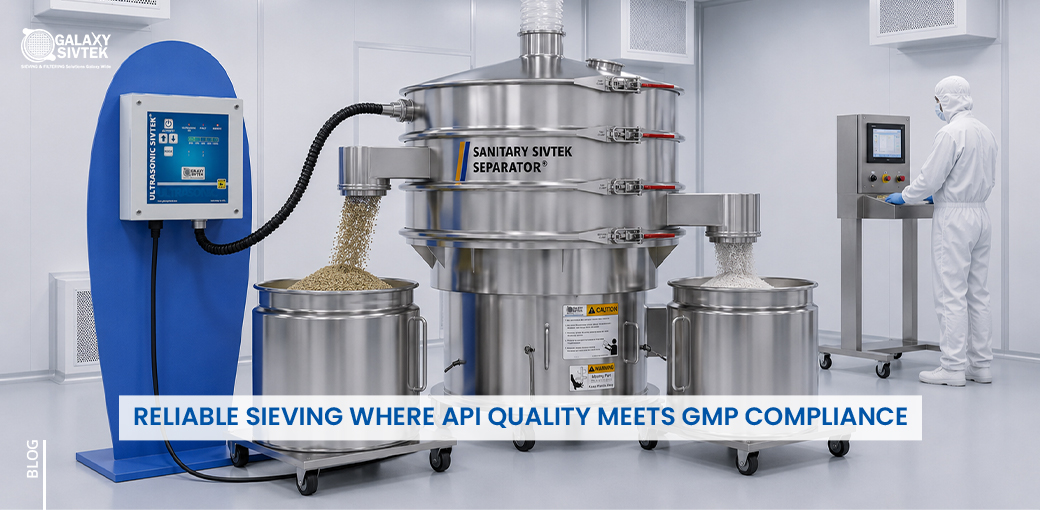
We replaced the existing sieving machine with our Sivtek Sanitary Separator — a GMP-grade pharma vibro sifter built specifically for critical pharma powder applications. It is constructed from high-grade 316L stainless steel with a mirror-polished, crevice-free internal finish. The fully enclosed design prevents API powder from escaping into the environment during sieving, eliminating both the contamination risk and the operator exposure issue in a single change.
The result in that plant was immediate. The plant head confirmed that there was not a single instance of API dust escaping into the processing environment after installation. The area stayed clean, and the health hazard that had been a constant concern was eliminated entirely.
To address mesh blinding, we added our Ultrasonic Sivtek to the Sivtek Sanitary Separator. This system transmits ultrasonic energy directly through the mesh screen of the vibro sifter during sieving. The high-frequency vibration prevents fine API particles from lodging in mesh openings — keeping the mesh continuously clear without any manual intervention.
The effect is twofold: throughput stays consistent throughout the production run because the effective screening area does not degrade, and particle size distribution in the screened material remains uniform from the first kilogram to the last. For an API plant where batch-to-batch consistency is not optional, this is a fundamental improvement to any sieving machine setup.
For plants that require a fully contained sieving system — particularly where the API is potent or where the processing environment must remain completely sealed — our Vacuum Sivtek provides a pneumatic inline sieving solution. Material is drawn into the sieving machine through a vacuum system, eliminating any open transfer point where powder could escape. Its compact design integrates directly into existing processing lines without requiring significant layout changes, and cleaning and maintenance are straightforward.
When the Sivtek Sanitary Separator — our GMP-grade vibro sifter — along with the Ultrasonic Sivtek was installed in the API plant we worked with, the difference in production performance was visible almost immediately. Process delays caused by mesh blinding stopped. The dirty processing environment was resolved. And when the plant checked its production rate a few days after installation, the improvement was significant — output was higher, stoppages were gone, and the quality of the screened material was consistent across batches.
This is what getting the sieving machine right actually delivers — not just compliance on paper, but real operational improvement that shows up in production numbers.
If your current vibro sifter is causing dusting, recurring mesh blinding, process stoppages, or inconsistent particle size in your API powder sieving machine is costing you more than you realise. Our experts at Galaxy Sivtek will assess your sieving process, identify where the gaps are, and recommend the right configuration for your specific API application.