Committed To Quality, Committed To You
In modern flour mills, efficiency is not just about grinding—it’s about how smoothly material flows through every stage. The flour sieving process at high-capacity milling facilities represents a critical component of their operations which people tend to ignore.
Many plants still rely on conventional systems that seem functional at lower volumes. However, at large scale, such systems begin to introduce new inefficiencies of scale such as interruptions, variable production, and increased maintenance.
Over time, what looks like a minor issue in sieving becomes a major bottleneck affecting throughput and product quality.
Conventional sieving setups are typically not designed for continuous flour processing lines. The biggest limitation is flow disruption.
The material usually requires to be diverted, screened and further reintroduced into the system. This slows down production and increases handling.
At the same time, performance becomes inconsistent. At different loads, the conventional systems do not exhibit consistent separation of particles- causing the quality of flour to vary.
Another critical concern is contamination. Open handling with several ways to transfer products increases the possibility of contamination from dust and other foreign particles and will be more difficult to maintain hygiene standards with food-grade flour.
Frequent mesh blockages also add to this problem and cause stoppages and an increased maintenance effort.
A flour mill sifter machine is created to ensure that these inefficiencies are eliminated through its working directly on the production line.
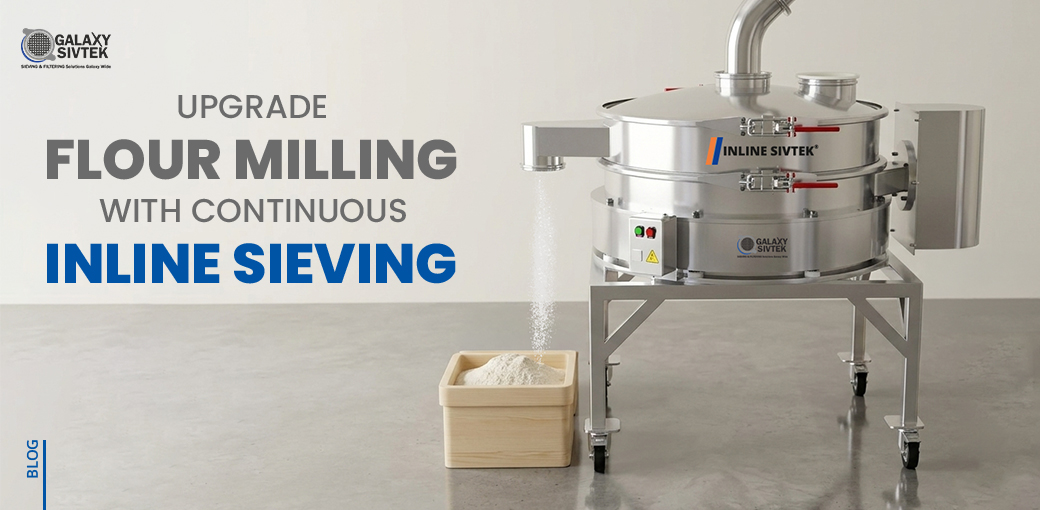
Rather than interrupting the flow, an inline sieving system to process flour continuously is used to perform real-time separation as material passes by. This will see to it that only correctly sized flour is carried on-without making the process any more slow.
In simple terms, it converts sieving from a separate step into a fully integrated, continuous operation.
In a inline arrangement, the flour is fed into a system via the upstream equipment such as grinders or conveyors. The inline vibro screen of the flour milling processes then uses controlled vibration to separate fine particles and oversized material and to remove impurities.
The main benefit here is continuity—there’s no need to halt or redirect the material, which leads to:
Inline sifter machines are ideally suited for high-volume applications where the interruption to the process can result in substantial cost increases.
With increasing production requirements, there is need for systems that will promote both efficiency and scalability.
Inline sieving systems address this by:
More importantly, they simplify operations. Mills with fewer transfer points and a closed design can be subjected to a better hygiene control and an easier compliance with food safety standards.
When mills upgrade to an inline sifter for industrial flour processing, the benefits are visible across operations.
Production is made more stable, few stoppages and improved throughput. With regular separation of particles, product quality improves; and with little clogging, the maintenance requirements drop.
These enhancements can be considered as incremental but when it comes to high capacity environments, they can be translated into high gains in terms of efficiency and cost reduction.
If your current system is causing:
…it’s a strong indication that your existing sieving setup is not aligned with modern milling requirements.
The expansion of flour mills requires sieving to become their main operation because it needs to establish continuous flow and maintain product quality and operational efficiency requirements.
The implementation of inline systems is a step forward in flour processing optimization where sieving should become the integral part of the process.
Solutions from Galaxy Sivtek are designed with this exact goal in mind—helping mills achieve reliable performance at scale.
If your current sieving system is limiting efficiency, it’s time to evaluate a smarter solution. Talk to our experts and see how inline sieving can unlock consistent flow and higher output.