Committed To Quality, Committed To You
In today’s process industries, the movement of materials is not just something that needs to be done but it has to be done accurately, hygienically, and with no impact on production. Whether transferring powders from sacks to silos or feeding batching systems from bulk storage, material movement has become a critical component of productivity. A well-engineered material handling system makes this possible by integrating conveying, dust-free loading, automated weighing, and screening into one smooth and controlled process that eliminates manual intervention and ensures consistent throughput.
With foods and beverages, chemicals, minerals, pharmaceuticals, nutraceuticals as well as plastics, production efficiency is no longer characterized by how the core process machinery should operate-but how raw materials should be taken to the processing point. It is here that integrated material handling solutions are important.
Although many factories have modern mixers, dryers, and packaging lines, material feeding and unloading is still often handled manually. The list of challenges arising from this approach is long:
Over time, these challenges translate into higher production costs, lower output consistency, safety risks, and unnecessary downtime. As such, many industries are working toward automating the Materials Handling process to alleviate these problems.
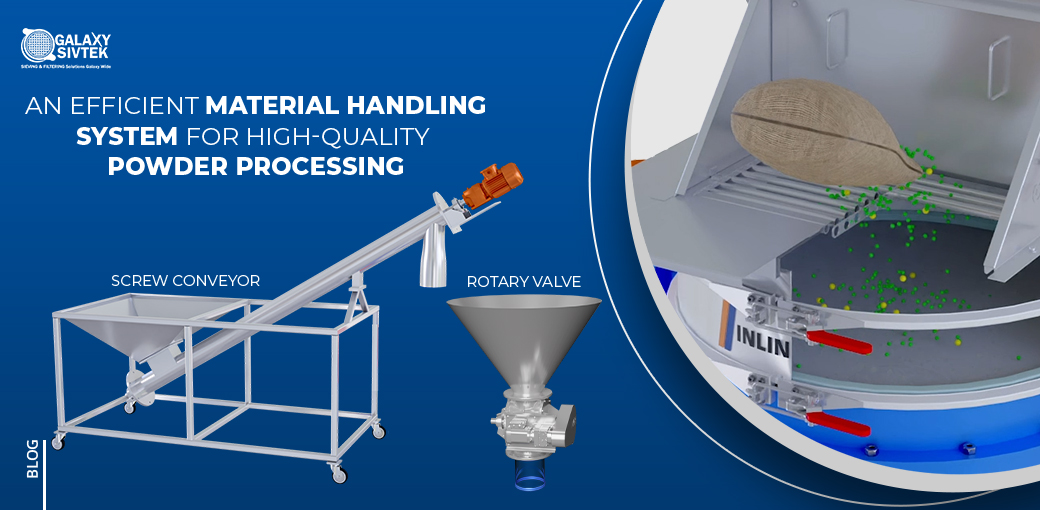
A Material Handling System consists of interconnected elements that automate the flow of powders from bulk storage or sacks all the way to processing or packaging. Each component plays a role in reducing labor involvement while enhancing flow uniformity, hygiene, and throughput.
Let’s examine how these various tools optimize the process of operations:
Specifically designed to safely unload from 500 kg to 2000 kg jumbo FIBC bags without manual cutting, lifting, or tilting.
Benefits include:
By automating bulk unloading, material feeding becomes continuous rather than batch-based.
For smaller bagged materials (20–50 kg), the Bag Dump provides an ergonomic and dust-free unloading platform.
Besides the magnetic grills, lump breakers, and dust collectors, it has other accessories which enable it to:
This ensures product purity right from the first step.
The most suitable solution for discharging drums, bins, and IBCs into the manufacturing process. With the addition of pneumatic vibrators and flow aids:
This streamlines ingredient changes and batch transitions.
Here is a temporary storage and flow-regulation unit that is the buffer between unloading and processing equipment.
Key advantages:
When matched to conveying speed, production stabilizes significantly.
Transfers powders from one station to another without any loss or release of dust.
Manual carrying is eliminated with both options, and contamination exposure is reduced.
Functions as a metering device between the conveying and processing equipment.
The main functions are
It’s a crucial link in achieving flow precision.
The bulk feeder delivers the material evenly to the screening machine in the final step of the handling process usually a Vibro Separator or Inline Sifter.
This automated pairing:
This is the point where final quality control begins.
Without going deep into technicalities, the role of the Vibro Sifter or Inline Sifter in the handling system is straightforward:
Switching from manual material feeding to an automated handling and screening installation yields advantages far beyond labour savings. It streamlines the entire production line, from unloading and conveying to feeding and final quality control.
Key advantages manufacturers immediately notice include:
Ultimately, automation doesn’t just move material — it keeps the process running smoothly, continuously and predictably.
Powder and granule industries are the ones that enjoy most, that is, food, pharmaceuticals, chemicals, minerals, plastics, spices, and detergent manufacturers.
Modern production demands uninterrupted flow, operator safety and uncompromising product quality — and a well-engineered Material Handling System delivers all three. By integrating bulk unloading, conveying, controlled feeding and screening into one automated line, industries can achieve faster throughput, higher yield and labour-free consistency across every batch.
If you’re looking to upgrade raw material feeding, achieve dust-free processing, and boost plant efficiency, our experts can help you design the right material handling solution for your application.