Committed To Quality, Committed To You
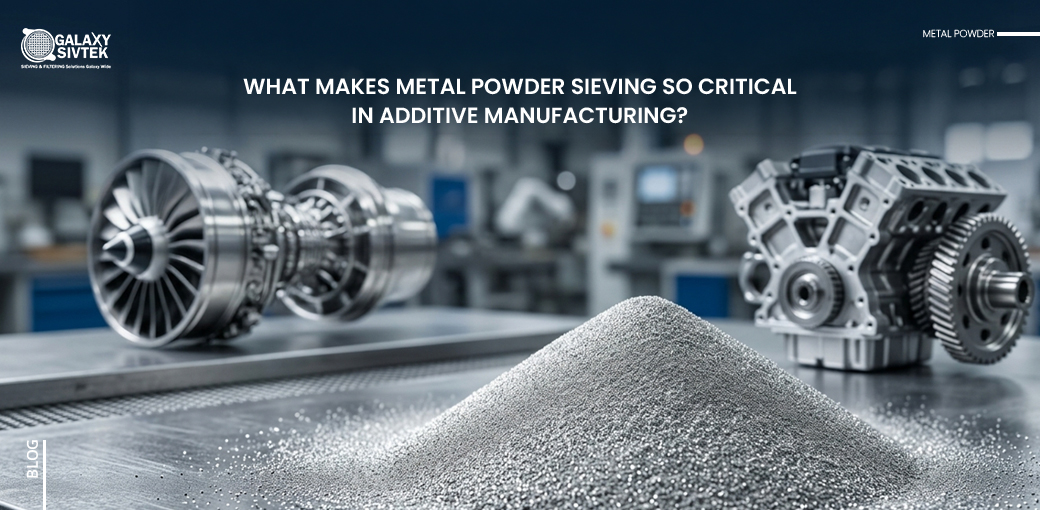
Additive manufacturing is rapidly changing how aerospace and automotive components are designed and produced. Manufacturers have increased their use of metal 3D printing to create lightweight aerospace structural parts as well as complex components for electric vehicles, where the key benefits are precision, material efficiency and design flexibility that can often be unattainable with traditional manufacturing processes.
But the quality of every printed component depends heavily on one factor that many processors underestimate — powder consistency.
Even the most advanced metal printing systems cannot produce reliable results if the powder feeding process contains oversized particles, agglomerates, contamination, or inconsistent particle distribution. This is why metal powder sieving for additive manufacturing has become an essential part of modern aerospace and automotive production.
In additive manufacturing, every printed layer depends on smooth and uniform powder flow. From printable components for aerospace applications, such as titanium alloys, to parts for jet engines, which are usually made from nickel superalloys, to the production of automotive components using stainless steel, the behaviour of the powder is always a direct factor in the quality of the print.
Particles that are too large disrupt layer thickness and create uneven fusion during printing. Extremely fine particles reduce flowability and lead to agglomeration inside the build system. Both affect dimensional accuracy, surface finish, and structural consistency of the final component.
Aerospace manufacturers typically work with particle sizes in the range of 15 to 45 microns — where tight particle distribution produces denser, more structurally reliable parts with zero tolerance for contamination or off-spec material.
Automotive and EV manufacturers operate in the 45 to 63 micron range, where throughput efficiency and precision must both be maintained across large production volumes. Same technology, different production realities — and the sieving solution must be configured for each.
Handling fine metal powders is far more complex than conventional material screening.
Agglomeration is one of the most persistent challenges. Fine metal particles naturally cluster together during storage, transportation, or powder reuse cycles. These agglomerates behave unpredictably during printing and directly affect powder spreading consistency across the build platform.
Contamination control is equally critical. The presence of foreign particles, over-sized material or oxidized particles in the powder stream can affect the integrity of the print, resulting in rejected components — a very critical and costly issue in aerospace applications where strict quality certifications apply.
Powder reuse is a growing challenge across both industries. In powder bed fusion processes, only a fraction of the loaded powder is consumed during each build. The remainder must be reclaimed, re-sieved, and re-qualified before safely returning to the process. Without precise metal powder grading at this stage, particle size distribution becomes unstable across multiple reuse cycles — directly affecting print repeatability and part quality.
This means sieving is not a one-time upstream step. It happens before every build and after every build — making it a recurring, production-critical process that must perform consistently under continuous operating conditions.
Galaxy Sivtek provides advanced sieving, screening and filtration solutions designed to handle the specific demands of fine metal powder applications in additive manufacturing.
For metal powder classification, post-build powder recycling, and contamination removal, the Sivtek Super Gyro Separator® delivers the performance these applications demand. Its high-energy gyratory motion generates consistent, sustained vibration across the full screen surface — keeping dense, cohesive metal powder moving efficiently without the static buildup that causes mesh blinding. This maintains precise screening accuracy across the full production run, not just at the start of a shift.
The machine’s accurate particle cut capability allows AM facilities to classify powder to the exact size fractions their build process requires. Multi-decks allows for the separation of multiple fractions in one pass, which is ideal for plants that have to handle both aerospace and automotive powder applications on the same line.
For applications requiring gentler handling of fine metal powder — where preserving spherical particle shape is critical for consistent flow and build performance — the Sivtek Tumbler Screen provides low-acceleration precision screening without fracturing or distorting particles.
Both solutions are designed in completely enclosed configurations, where contamination during screening is not an option, which is essential for an aerospace or automotive additive manufacturing environment.
For aerospace and automotive manufacturers, achieving consistent additive manufacturing results requires more than advanced printing technology. It requires stable powder grading, controlled particle separation, reliable contamination management, and a sieving process that holds its performance across continuous production and multiple powder reuse cycles.
By investing in the right metal powder sieving solutions for additive manufacturing, manufacturers can improve print consistency, reduce rejected components, support efficient powder reuse, and maintain the quality standards that aerospace and automotive buyers demand — batch after batch, build after build.
Galaxy Sivtek’s application team works with additive manufacturing facilities to configure the right advanced sieving, screening and filtration solution for each metal powder type, particle size specification, and production throughput requirement.
Connect with Galaxy Sivtek to discuss your metal powder sieving and screening requirements for additive manufacturing.