Case Study: Solving a Low-Headroom Metal Powder Screening Challenge in an Existing Process Line
Overview
Adding a screening machine to an existing production line is not always a simple equipment-selection exercise. Even when the material, mesh requirement, and capacity are known, the available installation space can determine whether a conventional screening machine is practical.
In this application, a manufacturer needed to introduce metal powder check screening before the material entered the next processing stage. The purpose was to remove lumps and unwanted material, but there was one major constraint: very limited vertical clearance between an upper storage station and the hopper positioned directly below it.
Both points were already aligned on the same centreline. The challenge was therefore to achieve effective metal powder screening while working within the existing process geometry.
The Challenge: Screening Where Headroom Was Limited
The customer’s existing arrangement left very little space for an additional screening machine.
A conventional Vibro Sifter was not suitable for the installation because its overall height and discharge arrangement did not match the available space and centreline material flow required between the storage point and the lower hopper.
At the same time, screening could not simply be skipped. Lumps and unwanted material needed to be removed before the metal powder continued into production.
The required solution therefore had to address several conditions together:
- limited installation height,
- direct vertical material flow,
- removal of lumps and unwanted particles,
- required production throughput,
- and reliable operation without frequent choking or maintenance interruptions.
This made the application as much an equipment-integration challenge as a screening challenge.
Galaxy Sivtek’s Low-Profile Solution
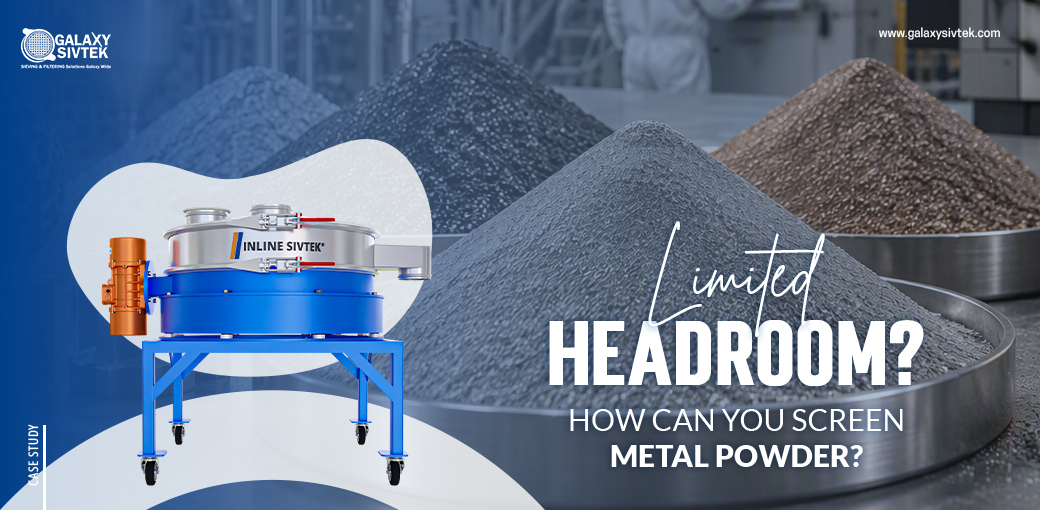
After studying the installation arrangement, Galaxy Sivtek recommended the Inline Sivtek® Dual Motor Separator.
A 62-inch Inline Sivtek® was selected for the process. Its low-profile configuration made it suitable for the restricted space available between the upper storage station and downstream hopper.
Unlike the conventional arrangement that had been considered, the Inline Sivtek® provides an inline material path, with the product inlet and discharge positioned to support direct flow through the machine.
Its two vibratory motors are mounted on the sides rather than underneath the screening chamber, helping reduce the overall machine height. Galaxy Sivtek specifically positions the Inline Sivtek® for check-screening applications where installation space is restricted.
For this application, that geometry allowed the screening stage to be incorporated into the customer’s existing low-headroom process arrangement.
How the Inline Screening Process Worked
Metal powder entered the Inline Sivtek® from the upper storage point.
The dual-motor vibration distributed the material across the screening surface, allowing acceptable powder to pass through the mesh and continue through the bottom outlet towards the hopper below.
Lumps and unwanted oversize material were retained and discharged separately.
The important point was that the process maintained the required vertical flow path while carrying out the check-screening operation within the restricted space available.
Instead of selecting equipment first and then trying to adapt the surrounding process around it, the screening configuration was chosen to suit the geometry already present in the production line.
Results
After installation, the Inline Sivtek® successfully handled the customer’s metal powder screening requirement and removed lumps and unwanted material before the powder moved to the next processing stage.
According to the documented customer feedback, the new setup also addressed earlier problems associated with choking and frequent maintenance, while throughput improved compared with the previous screening arrangement.
The installation helped the customer achieve:
- effective lump and unwanted-particle removal,
- reduced choking during operation,
- lower maintenance intervention,
- improved screening throughput,
- and successful screening within a restricted-headroom area.
The key outcome was not simply improved screening performance. It was achieving the required separation within the physical limitations of the existing process line.
Why Installation Geometry Matters in Screening Equipment Selection
Mesh size and capacity are important when selecting a screening machine, but they are not the only factors.
In existing plants, engineers also need to consider:
- available headroom,
- inlet and outlet alignment,
- surrounding equipment,
- material-flow direction,
- and how the machine will physically integrate into the current process.
A machine that meets the required throughput but cannot be practically installed does not solve the application.
This case shows why equipment selection needs to consider the complete process arrangement, not only the powder being screened.
Conclusion
Limited headroom can become a significant challenge when introducing metal powder screening into an established production line.
For this application, Galaxy Sivtek used a 62-inch Inline Sivtek® Dual Motor Separator to provide effective check screening while matching the customer’s existing centerline flow between the upper storage station and lower hopper.
The solution removed lumps and unwanted material, reduced choking and maintenance issues, improved throughput, and provided a practical screening configuration for a space-constrained installation.
Talk to Galaxy Sivtek’s experts to evaluate the right low-profile screening solution for your process line.